2005.11.27 | 27 novembre 2005
Foodblogs & Bonus Recipe
One curious food blog written in 2002/2003 (it's still accessible but inactive) chronicled a challenge to cook all the recipes in Julia Child's Mastering the Art of French Cooking, (1961) with introduced French food to the mainstream American home kitchen. The blog is entertaining, and it's written in a lively style, with plenty of f**** this and f**** thats. Julie Powell just published a memoire, "Julie and Julia: 365 Days, 524 Recipes, 1 Tiny Apartment Kitchen."
I've nearly finished reading it, what I found most irritating was that she made cooking seem like a chore -- was it to make herself look more prolish that she really is? -- Even though you know she loved doing it.
A regular food blog written by Clotilde Dusoulier who writes in English, "Chocolate&zucchini" is very well documented and I'm a devoted reader, there are many good links, including one blog that inspired the author: "An Obsession with food".
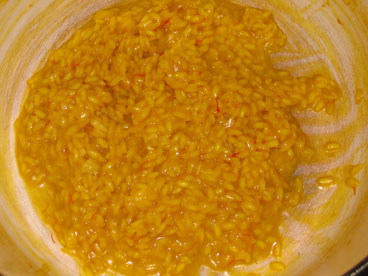
I've recently started cooking Italian risotto, Milanese style, with saffron. (See details in any good Italian cookbook).
(1) Proportion of Arborio or other Italian rice to liquid (white wine + broth) 1/2 volume of rice to 2 volumes of broth.
(2) Reduce onion or shallot, add rice and cook for 5 minutes until white and creamy in onions and olive oil, add wine first. Let rice absorb it.
(3) Then add warm broth, first stirring a little, then add dissolved saffron strands, then add remaining broth stirring consistently.
(4) Make sure heat is sufficient.
(5) Time for al dente rice around 20 to 25 minutes.
(6) Finish off adding grated fresh Parmigiano-Reggiano and fresh butter. Let sit 3 minutes.
I highlighted in bold type the parts many cookbooks do not get right.
Carnets culinaires et recette en prime
Je commence par mes conseils pour le risotto à la milanaise, il ne s'agit pas d'une recette mais de quelques observations essentielles (en gras) sur lesquelles les livres de cuisine se contredisent comme à l'habitude.a) La proportion entre le riz Arborio (ou un autre riz italien), et le liquide (vin blanc + bouillon) doit être de 1/2 volume pour 2 volumes de bouillon. J'ai donc développé une formule pour 1 à 1,5 personne très utile en petit comité.
b) Après avoir fait revenir l'oignon ou l'échalote et que le riz est devenu bien crémeux (environ 5 minutes), ajouter le vin blanc en premier. Laisser absorber.
c) Puis rajouter le bouillon chaud, absorbé par le riz, ensuite les pistils de safran dilués dans du bouillon chaud, puis le reste du bouillon en remuant régulièrement.
d) Attention, la cuisson doit se dérouler à une température suffisante.
e) Pour une cuisson al dente, compter environ 20 à 25 minutes.
f) Terminer en rajoutant du parmesan frais râpé et du beurre. Laisser reposer trois minutes et servir.
Un bloc-note des plus curieux : « Paris restaurants » constituté d'un flux de longs billets exhaustifs sur les restaurants parisiens, la cartes des vins et autres digressions. Style et originalité caractérisent ce carnet gastronomique parisien (dans l'esprit d'un Idle Words US), avec parfois des allusions littéraires et quelques clins d'œil mystérieux à des personnalités du monde de la politique et des arts. Je recommande de consulter aussi les billets anciens. La langue française y est maniée avec subtilité.
Miam-miam est site Web culinaire qui contient des infos intéressantes notamment une page sur le risotto. Autre carnet culinaire : cuisine et compagnie.
Une carnetière Française installée aux États-Unis nous ouvre sa cuisine, avec quelques observations interculturelles intéressantes. Mention particulière pour le carnet de Clotilde Dusoulier dont la rédaction en anglais (américain) est d'excellente facture pour une francophone.
2005.10.30 | 30 octobre 2005
Montaigne and his Books
"These two kinds of association [that of conversations with men and interactions with beautiful women] are accidental and dependent on others. One is annoying by its rarity, the other withers with age; thus they would not have provided well enough for the needs of my life. Association with books, which is the third kind, is much more certain and more our own. It yields the other advantages to the first two, but it has for its share the constancy and ease of its service. It is at my side throughout my course [life], and accompanies me everywhere. It consoles me in old age and in solitude. It relieves me of the weight of a tedious idleness, and releases me at any time from disagreeable company. It dulls the pangs of sorrow, unless they are extreme and overpowering. To be diverted from a troublesome idea, I need only have recourse to books: they easily turn my thoughts to themselves and steal away the others. And yet they do not rebel at seeing that I seek them out only for want of those other pleasures, that are more real, lively, and natural; they always receive me with the same expression."
The
Complete Essays of Montaigne, Book III:3, p.628
Translated by Donald M. Frame
Stanford: Stanford University Press, 1958.
Seventy-five copies of books annotated by Montaigne have been found, his library is presumed to have contained more than a thousand books, a lot for only a little more than a century after the invention of printing with movable type.
Montaigne et ses livres
« Ces deux commerces sont fortuites et despendans d'autruy. L'un est ennuyeux par sa rareté ; l'autre se flestrit avec l'aage ; ainsin ils n'eussent pas assez prouveu au besoing de ma vie. Celuy des livres, qui est le troisiesme, est bien plus seur et plus à nous. Il cede aux premiers les autres avantages, mais il a pour sa part la constance et facilité de son service. Cettuy-cy costoie tout mon cours et m'assite par tout. Il me console en la vieillesse et en la solitude. Il me descharge du pois d'une oisiveté ennuyeuse ; et me deffaict à toute heure des compaignies qui me faschent. Il emousse les pointures de la douleur, si elle n'est du tout extreme et maistresse. Pour me distraire d'une imagination importune, il n'est que de recourir aux livres ; ils me destournent facilement à eux et me la desrobent. Et si, ne se mutinent point pour voir que je ne les recherche qu'au deffaut de ces autres commoditez, plus reeles, vives et naturelles ; il me reçoivent tousjours de mesme visage ».[Orthographe non modernisée]
Montaigne, Essais, Livre III, Ch 3, p.43,
ed. Maurice Rat, Editions Garnier, Paris, 1948On a retrouvé 75 exemplaires de livres annotés par Montaigne, en outre il aurait possédé au moins mille livres dans sa « librairie », chiffre élevé une centaine d'années seulement après l'invention de l'imprimerie.
This is a work licensed under a Creative Commons License.
