2004.09.26 -- 26 septembre 2004
Primary Elections
- On Saturday, September 18, I voted in the Primary Elections, here in Honolulu. The voting went smoothly, I felt it was well organized; the voting system seems like a good compromise between total electronic automation with the ensuing controversies and pure plain-paper ballots. The full-fledged electronic voting machines used in some states are the most controversial (See articles in Wired). Currently in Hawaii, electronic voting machines are reserved for people with impairments; the main system used is an optical scanner that reads a paper ballot, so there is a paper trace left after the vote. (See sample ballot online). You take your ballot after its number is recorded into a ledger, which you sign, a photo I.D. is required. You fill in the boxes in the private election booth, slip it into a temporary folder for privacy and walk over to a Procter who watches you insert it into an electronic scanner (you keep a receipt), the scanner rejects erroneously filled in ballots. This was a major problem for absentee voters, apparently they did not understand that on one side you could only vote according to party lines (people wanted to mix and match), as a result, 3.8% (9,559) of the ballots were invalidated. At the actual voting precinct, you could revote if the scanner rejected your ballot, provided enough blank ballots were available. The vote concerned the election of Federal and State senators and representatives, seats on the Board of Education, the Public Prosecutor and the Mayor of Honolulu. The Honolulu Advertiser published a detailed election guide.
Elections primaires à Hawaï
- J'ai voté dans les élections primaires à Honolulu, le 18/9/04. Ils utilisent un système de bulletin papier (noircir les cases, mais sur la face A, uniquement pour un seul parti : Indépendant, Libertarian, Républicain ou Démocrate) ayant pour résultat l'invalidation d'un certain nombre de bulletins envoyés par correspondance en effet les électeurs ayant fait preuve d'oecuménisme en voulant panacher leurs voix, toutefois, les électeurs s'étant rendus aux urnes pouvaient éventuellement revoter car le numériseur rejetait les bulletins défectueux, il faut dire que le procédé, même s'il parait exempt des pires défauts constatés dans d'autres États américains, est complexe étant donné le nombre de postes à élire, notamment les sénateurs et représentants fédéraux et locaux de certains districts, des membres des conseils d'éducation, des députés locaux selon les circonscriptions et le procureur d'Honolulu, et surtout le maire de la ville, c'était l'élection la plus suivie. Donc après avoir émargé sur la liste des électeurs inscrits au bureau de vote, un assesseur vous donne un bulletin de vote papier et l'on se dirige vers l'isoloir (il faut voter sur les deux faces en noircissant des petites cases, on doit voter en tout pour une dizaine de personnes), une fois le bulletin rempli, on sort de l'isoloir en ayant pris soin de placer le bulletin de vote de format A3, (disponible en anglais, chinois, illocano [dialecte philippin], japonais), dans une grande chemise, puis on se dirige vers le numériseur, qui prend le bulletin et l'avale (il rejette les bulletins erronés).Sur le vote électronique, voir la note intéressante de padawan.info. Sur les élections en France, voir les informations du ministère de l'Intérieur.
2004.09.06 -- 6 septembre 2004
Re-reading Great Fiction
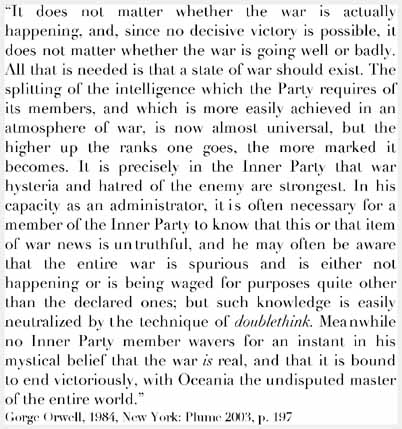
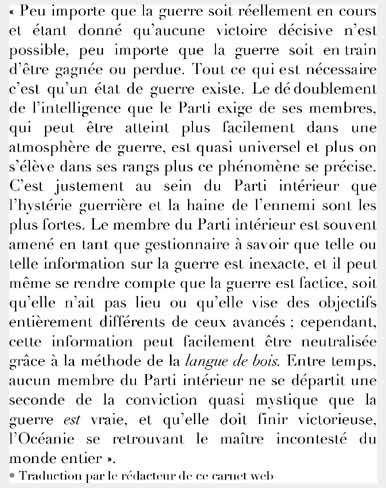
- One of the first books of serious English fiction that I thoroughly enjoyed was George Orwell's 1984 which I read in 1968. It may even be the first "real" novel I read. I just picked up the centennial edition, with a new foreword by Thomas Pynchon, Plume, Harcourt Brace 2003. It's a beautifully printed softcover edition, set in Bauer Bodoni (the quote below is in Didot, of the same family of typefaces). A free etext is also available for download.
I remembered the book quite well but was struck by its current relevance and though it was written in British English in 1948, its style is very clear and straightforward.
Here is an interesting Newspeak Dictionary.
Why read fiction over again?
(1) In order to simply recall a great book.
(2) Because we change, if you read a book at 15 you won't react to it the same way at 50, though in this case 1984 stood the test of time, I found it just as compelling if not more so. The passage quoted above shows how eerily relevant Orwell still is.
(3) For the pleasure of a well-written text, feeling the freedom to skip around since you've already read the story "chronologically".
(4) I would certainly choose the books I re-read carefully because you only can read so many books in a lifetime and there a plenty of new ones and classics I have yet to read (See: How to Read Difficult Books, referring in particular to James Joyce's Ulysses, which I have had difficulty reading in full). One great novel I plan to eventual re-read [I first read it entirely in 1982] Marcel Proust's Remembrance of Things Past (new title In Search of Lost Time).
Relire les grands classiques
- Un des premiers livres que j'ai lu vers 15 ans en 1968 était « 1984 » de George Orwell. Je viens de le relire dans une nouvelle réédition en poche de luxe avec une typographie très soignée (composé en Bauer Bodoni, la citation ci-dessus est en Didot). Le texte électronique gratuit en anglais est disponible sur le site etext library.
Le livre est paru en français (Folio poche) dans une traduction de Amélie Audiberti.
À la relecture ce qui m'a frappé c'est l'actualité du livre et son style qui reste toujours vivant et non teinté d'un style trop britannique.
Un dictionnaire de la « novlangue » ou Newspeak est disponible en anglais ici.
Pourquoi relire des romans ?
a) Simplement pour se souvenir d'une bonne histoire.
b) Parce que nous changeons, on n'est pas le même à 15 ans qu'à 50. En l'espèce, le livre à passé l'épreuve du temps, il m'a paru aussi bon sinon meilleur qu'il y a 35 ans.
c) Pour le plaisir du texte. On peut même se permettre de sauter des passages et de lire dans le désordre car on connaît déjà l'intrigue.
d) Il faut certes bien réfléchir aux choix des livres à relire car il reste tant d'excellents livres classiques et contemporains que je n'ai pas encore lus. (Voir, en anglais, Comment lire un livre réputé difficile, notamment en référence à Ulysse de James Joyce (une nouvelle traduction vient de paraître chez Gallimard en 2004). Autre grand roman que j'ai l'intention de relire c'est À la recherche du temps perdu de Marcel Proust que j'ai l'intention de relire dans l'édition La Pléiade de 1954 (en consultant peut être les variantes de l'édition La Pléiade 1987-89).
2004.08.15 -- 15 août 2004
What a Difference Ten Years Makes
- Amazingly the PowerBook Duo 230 and the PowerBook G4 (revision C: 10.9" wide; 8.6" depth, 1.18" thick) have similar footprints, the G4 is a little heavier (4.6 lbs) but more compact. Closed, it's thinner than the Duo 230.
That old Duo still works but it has to be plugged in, all my batteries for it are dead. It's really only a collector's item -- soon to be museum piece -- nevertheless there is a certain lineage between the two. And it's the first computer with witch I connected to the World Wide Web.
The Duo clock speed is 33 MHz (compared with 1.33 GHz for the G4 laptop), memory: initially 8 Mb (but boosted to 24 MB in 1997), internal HD was 80 Mb, with a 16-level grayscale monitor. There was no internal floppy drive, an external floppy drive had to be connected and it required a mini-dock or docking-station for extra ports and functionality!
In contrast, the PowerBook G4 is a fully functional machine (with a CD-R/DVD-R SuperDrive). Ram: 768 Mb, (256 out of the box). Hard drive: 60 Gb. Due to an interruption in land-line telephone connections here at the Diamond Head Digital Dungeon last week I was able to fortuitously test the built-in WI-FI connection on a open network in a location I am sworn to keep secret: Great, set-up was magically simple and I downloaded an 85 Mb system update in five minutes!
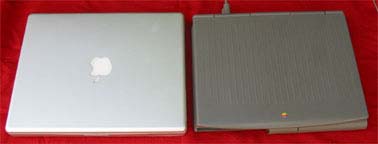
Côte-à-côte les PowerBook G4 12 pouces et Duo 230 (écran 9 pouces)
The G4 12" & Duo 230 9" PowerBooks side by side
Évolution étonnante sur dix ans
- Coïncidence : les deux portables sont presque de la même taille, le PowerBook G4 (révision C) mesure 27,7 cm de large, 21,9 de profondeur et 3 cm d'épaisseur, poids : 2,1 kg. Le PowerBook G4 semble un peu plus lourd que le PowerBook Duo 230.Ce vieux Duo 230 fonctionne toujours, mais les batteries sont mortes, il doit donc être branché sur le secteur. C'est un objet de collection à l'heure actuelle, mais il permet bien de mesurer l'évolution en puissance des portables Apple, ces deux appareils ayant une certaine filiation, ce qui m'a donné l'idée de faire ce rapprochement. C'est en outre le premier ordinateur avec lequel je me suis branché sur le réseau Internet et la Toile.
La vitesse d'horloge du Duo 230 est de 33 Mhz (comparé à 1, 33 Ghz pour le G4 12 pouces). Mémoire : à l'achat en 1993, 8 Mb (augmenté à 24 en 1997), le disque dur est de 80 Mb, avec un écran à 16 niveau de gris. Il ne dispose pas de lecteur de disquette, il faut en rajouter un externe, livré avec l'appareil. En outre, un mini-dock ou une station d'accueil permet d'accroître la connectivité.
En
revanche, le nouveau PowerBook G4 est totalement
opérationnel (ce modèle dispose d'un lecteur
CD-R/DVD-R) sa mémoire vive est de 768 Mb et le
disque dur de 60 Gb. À cause d'une panne de
réseau téléphonique dans mon quartier
je n'ai pas pu me connecter à Internet la semaine
dernière de chez moi, j'en ai profité pour
tester mon nouveau portable avec sa carte
intégrée Airport Express sur un
« réseau Wi-Fi »
non-protégé, dans un lieu tenu secret, la
connexion s'est révélée d'une
simplicité magique enfantine et j'ai
pu télécharger une mise à jour
système de 85 Mb en moins de 5 minutes en
haut-débit (contre plus de 5 heures par modem
V.92).
This is a work licensed under a Creative Commons License.
